
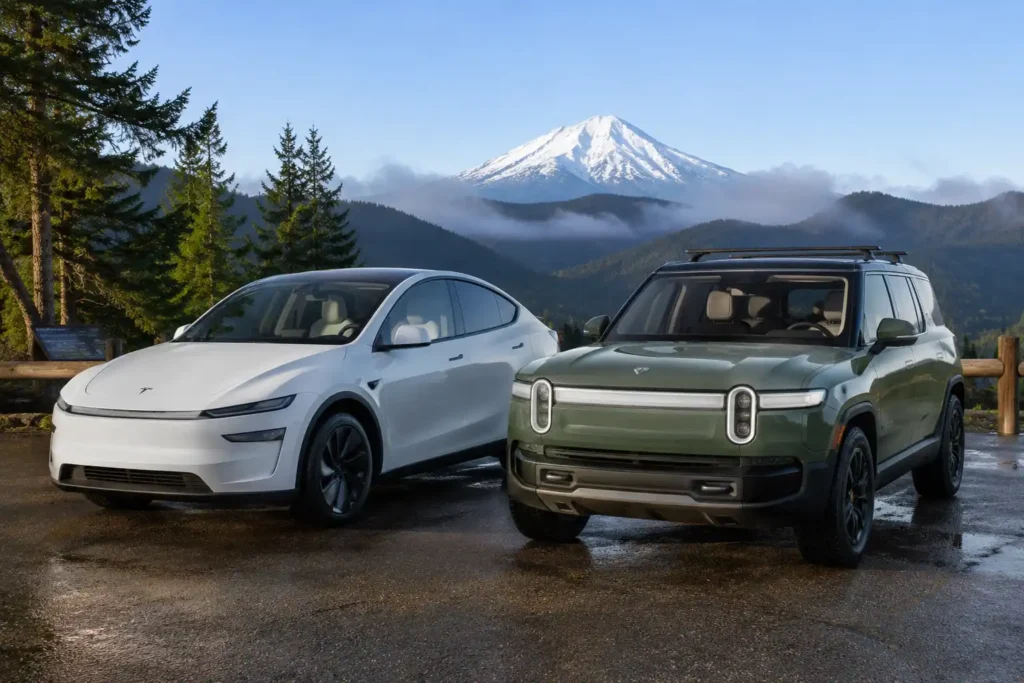
The choice between the Tesla Model Y vs Rivian R2 comes down to your driving environment. The Tesla Model Y remains the efficiency and on-road handling champion, offering lower entry pricing and an established service footprint. The Rivian R2 wins on rugged versatility, featuring 9.6 inches of ground clearance, superior total cargo volume, and a characterful, adventure-ready design. Both share native NACS charging access.
Introduction
The midsize electric crossover segment is no longer a monopoly. For half a decade, the Tesla Model Y has enjoyed an unprecedented run as the default answer for anyone seeking a practical, tech-forward family EV. It did not just lead the segment; it became the best-selling vehicle on earth. But the automotive landscape in 2026 is radically different than it was a few years ago.
Enter the Rivian R2. Fresh off production lines and hitting American roads with massive momentum, the R2 is the first direct existential threat to Tesla’s crown jewel. Built on an entirely new midsize architecture, the R2 shrinks Rivian’s rugged, adventure-first brand ethos into a highly competitive package aimed square at the heart of the mainstream market.
If you are standing in your driveway trying to decide where to deploy your hard-earned capital, this is the ultimate luxury dilemma. Should you go with the established, ultra-refined, and aerodynamic benchmark that is the refreshed Model Y? Or do you jump on the reservation list for the boxy, character-rich, and trail-ready newcomer from Normal, Illinois? We have spent real time behind the wheel of both, dug deep into the engineering specs, and mapped out the financial realities of owning these two software-defined vehicles to help you make the right call.
Why This Matters in 2026
The year 2026 represents a critical inflection point for electric vehicles. The “early adopter” phase is ancient history. Today’s buyers demand real utility, seamless road-tripping infrastructure, and stable residual values.
Two major shifts make this specific comparison incredibly urgent right now:
- The Great NACS Convergence: The historical “charging moat” that kept buyers locked into the Tesla ecosystem has vanished. The Rivian R2 ships with a native North American Charging Standard (NACS) port integrated directly into its rear quarter panel. It pulls up to Tesla Superchargers without adapters, giving it identical plug-and-play access to the continent’s most reliable fast-charging network.
- Point-of-Sale Incentives: With federal EV tax credit regulations highly focused on domestic battery supply chains, both of these American-built crossovers—the Model Y out of Texas and California, and the R2 out of Illinois—are positioned to maximize federal incentives, making them highly competitive with traditional internal combustion alternatives.
Main Content Sections
Design, Footprint, and Visual Presence
Park these two vehicles side-by-side, and their conflicting philosophies become immediately obvious. The Tesla Model Y continues to refine its jellybean-like silhouette. It is slippery, boasting a remarkably low coefficient of drag optimized purely for cutting through the wind. The 2026 refresh brings slimmer headlights, improved acoustic glass, and a slightly sharper front fascia, but it remains an exercise in aerodynamic minimalism.
The Rivian R2 is the anti-jellybean. It is a proudly boxy, mini-R1S with upright glass, a horizontal full-width light bar, and a muscular, Tonka-toy stance. While it is actually 2.7 inches shorter in overall length than the Model Y, it stands a full 3 inches taller. This gives the R2 a commanding road presence that looks ready to tackle a mountain pass, whereas the Model Y looks perfectly at home in a Silicon Valley parking garage.
Powertrain, Performance, and Driving Dynamics
When it comes to raw mechanical numbers, the hair-splitting is fascinating. Let’s look at the top-tier trims, where both manufacturers throw their best engineering forward.
The Tesla Model Y Performance utilizes its lightweight, 4,500-pound curb weight to exceptional effect. Pumping out roughly 510 horsepower through its dual-motor all-wheel-drive system, it rockets from 0 to 60 mph in a blistering 3.3 seconds. On asphalt, the Model Y drives like a tall sports sedan. The steering is lightning-fast, body roll is exceptionally well managed, and it feels agile, albeit firm over harsh urban potholes.
The Rivian R2 Performance Launch Edition approaches performance with brute force. It features a massive dual-motor configuration throwing down 656 horsepower and 609 lb-ft of torque. Because the R2 is a heavier machine—tipping the scales near 4,850 pounds due to its ruggedized chassis and larger battery pack—it hits 60 mph in 3.6 seconds. While a hair slower than the Tesla off the line, its mid-range passing power (50 to 70 mph) is absolutely ferocious.
Unlike the air-suspended R1 models, the R2 relies on a sophisticated coil-spring suspension paired with electronic semi-active dampers. The result is a ride that eats large road imperfections for lunch while maintaining a remarkably flat cornering posture.
Off-Road Capability: A Tale of Two Geometries
If your lifestyle includes anything rougher than a groomed gravel driveway, this section settles the debate immediately.
- Tesla Model Y: Offers a car-like 6.0 inches of ground clearance. Its underbody is entirely flat but unprotected against sharp rocks, and its front overhangs are strictly designed for the highway.
- Rivian R2: Delivers a class-leading 9.6 inches of ground clearance riding on 32-inch all-season or all-terrain tires. Coupled with a 25-degree approach angle and a 26-degree departure angle, the R2 can legitimately tackle moderate off-road trails, rutted fire roads, and deep snow banks that would tear the front bumper right off a Tesla.
Interior Comfort, Technology, and Living Space
Inside the cabins, the contrast between “stark minimalism” and “adventurous utility” is stark.
Tesla’s refreshed Model Y cabin remains heavily screen-dependent. There is no instrument cluster behind the steering wheel; everything from your speed to your windshield wiper controls is hosted on the central 15-inch display. The materials are premium, featuring high-quality vegan leather and textile dashes, but the lack of physical buttons remains a polarizing talking point. Crucially, Tesla still refuses to support Apple CarPlay or Android Auto, relying instead on its proprietary navigation and media apps.
The Rivian R2 interior feels like an upscale REI flagship store. It features a highly requested 12.3-inch digital gauge cluster right in front of the driver, complemented by a massive 15.6-inch center screen. The materials include sustainable open-pore birch wood accents and tactile, ruggedized switches that feel built to survive a lifetime of muddy hiking gear.
The R2’s party piece is its unmatched interior flexibility. Every single seat in the R2—including the driver and front passenger seats—folds completely flat. This transforms the cabin into an instantaneous, indoor car-camping platform that easily fits a full-size air mattress. Combine that with a fully roll-down rear tailgate window for open-air airflow, and the R2 cements its status as the ultimate outdoor utility tool.
Pros and Cons
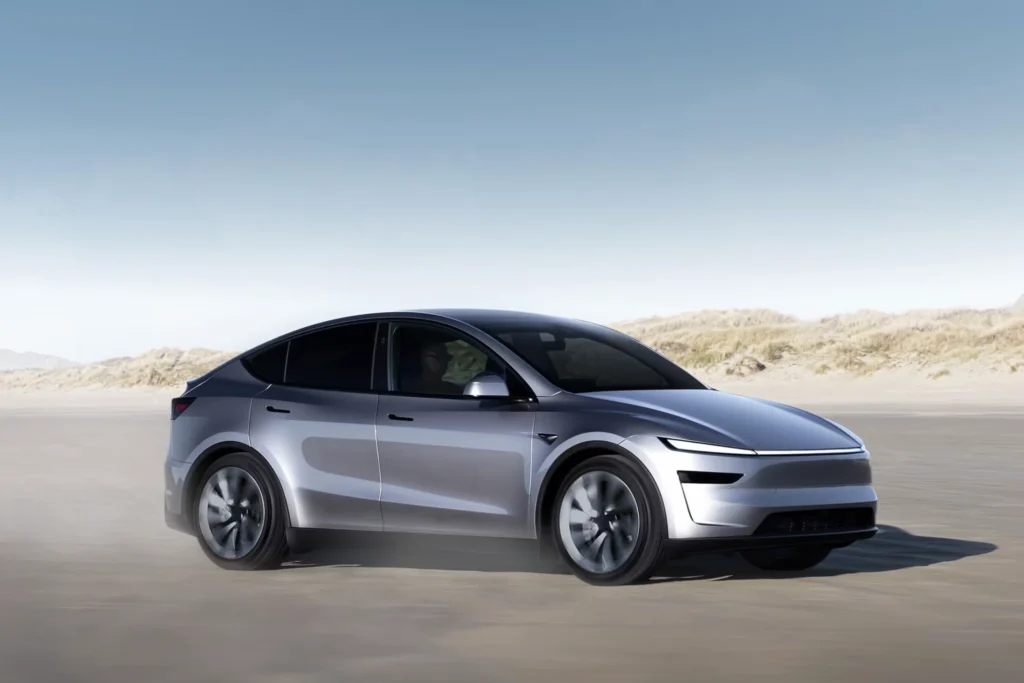
Tesla Model Y
- Pros:
- Slippery aerodynamics yield top-tier highway efficiency.
- Slightly quicker 0-60 mph acceleration in top specs.
- Massive, mature global service and parts infrastructure.
- Available 7-passenger configuration (third-row option).
- Cons:
- Minimalist interior lacks a driver gauge display and physical controls.
- No native Apple CarPlay or Android Auto compatibility.
- Limited 6.0-inch ground clearance prevents any real off-roading.
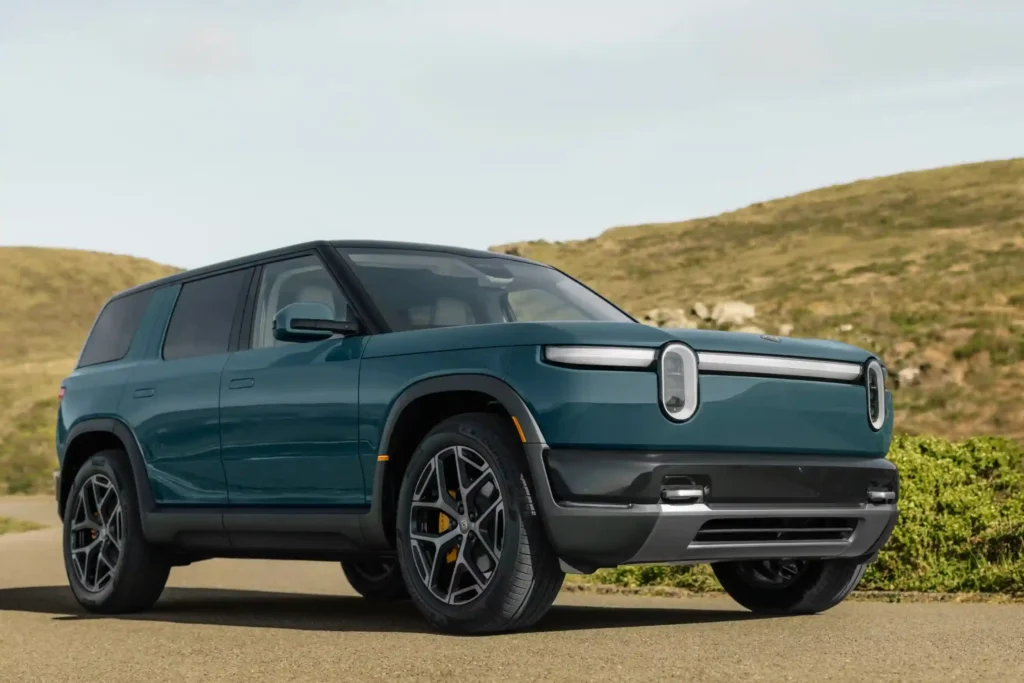
Rivian R2
- Pros:
- Superb 9.6 inches of ground clearance with excellent off-road geometry.
- Unique fold-flat front and rear seats ideal for car-camping.
- Driver-facing gauge cluster and premium open-pore wood accents.
- Roll-down rear tailgate glass and dual gloveboxes add immense utility.
- Cons:
- Heavier weight compromises absolute track handling agility.
- Base RWD models ($45,000) delayed to late 2026/early 2027.
- Rivian’s physical service center footprint is still scaling up compared to legacy networks.
Comparison Table
| Feature / Spec | 2026 Tesla Model Y Performance | 2026 Rivian R2 Performance | Winner |
| MSRP (As Tested) | $51,490 | $57,990 | Tesla Model Y (On Price) |
| Horsepower | ~510 hp | 656 hp | Rivian R2 |
| 0-60 mph Time | 3.3 seconds | 3.6 seconds | Tesla Model Y |
| EPA Range (21″ Wheels) | 306 miles | 328 miles | Rivian R2 |
| EPA Efficiency (MPGe) | 104 combined | 109 combined | Rivian R2 |
| Ground Clearance | 6.0 inches | 9.6 inches | Rivian R2 |
| Total Max Cargo Space | 76.0 cu ft | 90.1 cu ft | Rivian R2 |
| Charging Port / Network | Native NACS / Supercharger | Native NACS / Supercharger | Tie |
Ownership Costs
Evaluating an EV requires looking past the window sticker. The Rivian R2 Performance packs an 87.9 kWh usable battery pack, while the Tesla Model Y Performance relies on an estimated 81 to 84 kWh pack.
Remarkably, despite the R2’s heavier, boxier profile, Rivian’s next-generation structural battery unit and drive units achieve an EPA rating of 109 MPGe combined, matching or slightly edging the Tesla’s 104 MPGe on identical 21-inch road setups. According to EPA datasets, assuming 15,000 miles of mixed driving per year at average residential electricity rates, both vehicles will cost roughly $700 to $750 annually to keep charged.
Maintenance costs are similarly neck-and-neck; neither vehicle requires traditional fluid changes or tune-ups. However, because the Rivian R2 is geared heavily toward lifestyle utility, expect to cycle through tires slightly faster if you frequently load down the vehicle or take advantage of its 4,400-pound towing capacity.
Insurance Considerations
Insurance costs remain a notable component of EV ownership economics. Tesla offers its own proprietary insurance product in select states, which utilizes real-time driving behavior data to lower premiums for safe drivers. If you live in a state where Tesla Insurance is available, insuring a Model Y can be significantly more affordable than traditional legacy carriers.
Rivian has scaled its own integrated insurance program, but because the R2 is built with highly robust, off-road-capable cast components and a sophisticated semi-active suspension system, comprehensive collision coverage can lean slightly higher. Always obtain specific quotes based on your zip code, as multi-policy discounts can dramatically alter the final premium.
Financing Considerations
In 2026, both the Tesla Model Y and the Rivian R2 qualify for the $7,500 Federal Clean Vehicle Tax Credit for eligible buyers, thanks to North American manufacturing roots. Tesla frequently runs promotional financing incentives (such as low APR promotional windows) to maintain factory production volume. Rivian, operating on a massive order backlog for the newly released R2, typically relies on standard market financing rates or competitive lease structures through its captive finance arm. If you plan to lease, check if the lessor passes the full tax credit directly into the capitalized cost reduction to lower your monthly obligation.
Best Alternatives
- Hyundai Ioniq 5: If charging speed is your absolute north star, the Ioniq 5’s 800-volt architecture juices from 10% to 80% in just 18 minutes. It trades off the R2’s off-road clearance for an ultra-spacious, retro-futuristic lounge interior.
- Chevrolet Equinox EV: For the ultimate value play, GM’s Ultium-based crossover delivers a massive 319 miles of driving range for a price point hovering around the mid-$30k range before tax credits, representing an exceptional family bargain.
Expert Verdict
The battle between these two vehicles marks the official maturity of the electric crossover market.
The Tesla Model Y remains the smart, pragmatic choice for the urban and suburban commuter. It is a highly optimized appliance that handles incredibly well on the street, offers an unmatched service network, and is simpler to buy today without dealing with reservation queues.
The Rivian R2 wins our emotional and practical vote for anyone who views their vehicle as a gateway to experiences. It successfully injects character, rugged capability, and incredible lifestyle packaging into a midsize footprint. It is not just an EV; it is an adventure platform that proves you do not have to sacrifice efficiency to explore off the beaten path.
Frequently Asked Questions
Can the Rivian R2 use Tesla Superchargers?
Yes. The Rivian R2 is built natively with the NACS port, meaning it can plug directly into any compatible Tesla Supercharger station across North America without needing an adapter.
Which vehicle has more cargo space?
The Rivian R2 wins on total utility. Thanks to its boxy design and fold-flat front seats, it delivers up to 90.1 cubic feet of total cargo volume, compared to 76.0 cubic feet in the Tesla Model Y.
Do both vehicles qualify for the federal EV tax credit?
Yes, both models are assembled domestically in the United States and meet the necessary requirements to qualify for the full $7,500 federal tax credit at the point of sale for qualifying buyers.
Conclusion
If your weekend consists of highway road trips, Costco runs, and navigating tight parking structures, save the extra cash and buy the Tesla Model Y. But if you find yourself loading up mountain bikes, camping at trailheads, or simply wanting an EV that stands out with genuine rugged charm and functional design innovations, the Rivian R2 is the undisputed new king of the crossover hill.
Read This Also
Best Electric SUVs Under $50k: Navigating the U.S. Family Crossover Battleground
Best Electric Cars Under $50,000 for 2026: Real-World Range, Charging, and Value Compared