
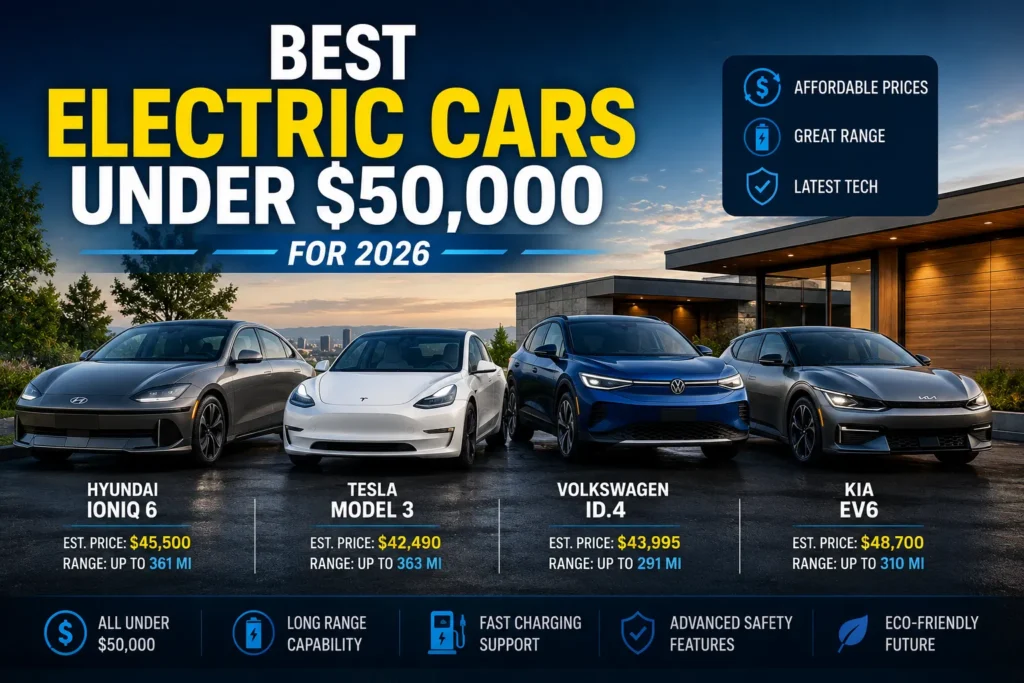
The conversation around electric vehicles has quietly shifted from a debate about futuristic ideals to a pragmatist’s calculus. The days of treating a sub-$50,000 budget as a compromise package are gone. Automotive manufacturers are no longer offering basic compliance cars; instead, they are engaging in an aggressive market share battle across American showrooms.
What is interesting here is that a $50,000 threshold no longer limits you to subcompact hatchbacks with restrictive ranges. It buys you advanced 800-volt charging architectures, sophisticated highway driver-assistance software, and multi-link rear suspensions designed to mask heavy battery packs on broken pavement.
The real story isn’t the headline performance figures or the minimalist aesthetic choices. It is how manufacturers are navigating changing regulatory landscapes, dealer inventory oversupplies, and consumer demand patterns to offer competitive packaging under the median U.S. new-car transaction price.
With the introduction of the One Big Beautiful Bill Act (OBBBA), the old upfront $7,500 point-of-sale credit has transitioned into a powerful multi-year tax deduction. Buyers with a modified adjusted gross income (MAGI) up to $100,000 for single filers or $200,000 married filing jointly can deduct up to $10,000 in auto loan interest annually through 2028—provided the car carries a VIN starting with 1, 4, 5, or 7, indicating final assembly in the United States.
This financial framework complicates the traditional sticker-price comparison. An imported EV with an attractive Manufacturer’s Suggested Retail Price (MSRP) might cost more over a five-year financing term than a domestic alternative that qualifies for the OBBBA interest write-off. We spent weeks tracking dealership inventory levels, charting public charging curves, and analyzing total cost of ownership variables to isolate the vehicles genuinely delivering on their promises.
The Benchmarks: Four Standout Contenders
1. Hyundai Ioniq 5: The Technological Standard-Bearer
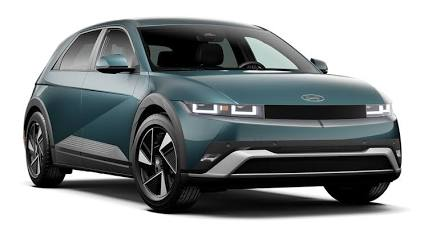
On paper, the Hyundai Ioniq 5 looks like a nostalgic design exercise. In practice, its pixelated light signatures and sharp creases mask a highly advanced platform that fundamentally changes how you interact with a mainstream EV. For the 2026 model year, Hyundai addressed its biggest mechanical oversight by shifting production for the U.S. market to its Metaplant facility in Georgia. This move aligns specific trims with federal tax incentives, fundamentally changing its competitive positioning.
| Specification | 2026 Hyundai IONIQ 5 |
|---|---|
| Starting MSRP | $35,000 (SE Standard Range RWD) |
| Tested Trim Price | $39,800 (SEL RWD) |
| Powertrain | Single-Motor Rear-Wheel Drive (RWD) |
| Horsepower | 225 hp |
| Torque | 258 lb-ft |
| Battery Capacity | 84.0 kWh (Long Range Versions) |
| EPA Estimated Range | 318 Miles (RWD Long Range) |
| Peak DC Fast Charging Rate | 240 kW |
| DC Fast Charging Time | 10% to 80% in Approximately 18 Minutes |
Driving Dynamics & Ride Engineering
The Ioniq 5 utilizes a MacPherson strut front suspension paired with a multi-link rear setup that has been recalibrated for the current model year. Weighing in at roughly 4,200 pounds depending on configuration, it manages its mass with a compliance that eludes many of its stiffly sprung rivals.
On broken urban pavement, the dampers filter out high-frequency road imperfections without inducing the unsettling secondary body oscillations typical of heavy, low-slung vehicles. The steering is light and largely devoid of road feel, but it tracks straight on the highway and features a tight turning radius that simplifies tight parking maneuvers.
Step up to the 320-horsepower dual-motor all-wheel-drive (AWD) option ($41,000 for the SE AWD), and the torque figure climbs from 258 pound-feet to a stout 446 pound-feet. It drops the 0-60 mph sprint from a relaxed 6.5 seconds down to a sports-car-baiting 4.5 seconds. For daily commuting, however, the rear-wheel-drive (RWD) variants offer linear acceleration away from stoplights and feel significantly punchier than their official horse-power figures suggest.
Cabin Functionality & Everyday Usability
Hyundai exploited the long 118.1-inch wheelbase of its Dedicated Electric Global Modular Platform (E-GMP) to craft an expansive, flat-floored interior. Front-seat occupants benefit from an open dashboard design that maximizes knee room, while the rear seats slide fore and aft to prioritize either legroom or cargo space. Rear legroom peaks at 39.4 inches, comfortably accommodating adults over six feet tall without requiring front passengers to compromise.
Cargo capacity is generous but slightly compromised by the vehicle’s raked rear glass. You get 27.2 cubic feet behind the rear seats, expanding to 59.3 cubic feet with the 60/40 split-folding seats laid flat. A small front trunk (frank) exists under the hood, but it is best reserved for a mobile charging cable or roadside emergency gear.
Software & Driver-Assistance Performance
The infotainment system relies on twin 12.3-inch displays housed in a single glass panel. Hyundai finally resolved a lingering consumer pain point by offering wireless Apple CarPlay and Android Auto across all trim levels as standard equipment. The native user interface is intuitive, utilizing large touch targets and keeping high-frequency adjustments like climate control anchored to dedicated physical buttons on the lower dash.
Hyundai’s Smart Cruise Control and Highway Driving Assist systems remain among the most reliable lane-centering and adaptive cruise setups on the market. They manage following distances smoothly without sudden braking inputs when traffic cuts into your lane.
Real-World Charging Realities
The true differentiator for the Ioniq 5 is its 800-volt electrical architecture. When connected to a 350 kW DC fast charger, it can accept a peak rate of 240 kW. This translates to an actual 10-to-80 percent charge time of just 18 minutes under optimal conditions. More importantly, its charging curve is flat; it sustains speeds above 150 kW past 60 percent state of charge, whereas rival platforms begin tapering aggressively at 50 percent.
Home charging is equally robust. A dual-amperage Level 1/Level 2 combination charger is now bundled with all models from the factory. On a dedicated 48-amp home wall box, the onboard charger pulls 10.9 kW, meaning an empty long-range battery can be completely replenished overnight in less than 8 hours.
2. Tesla Model 3: The Efficiency and Software Purist
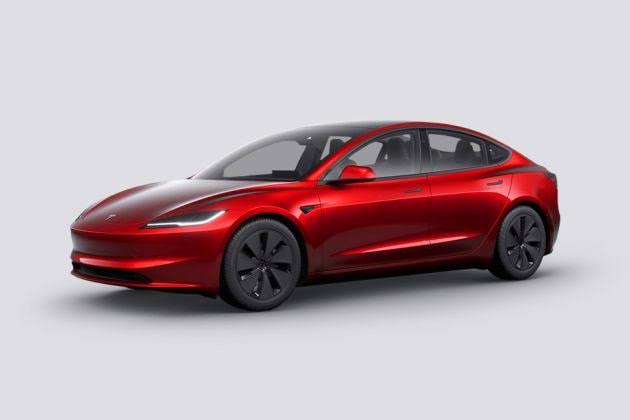
The Tesla Model 3 remains the default baseline against which all other affordable electric vehicles are judged. Following its comprehensive structural and aesthetic refresh, it has evolved from a somewhat unrefined entry-level sedan into a quiet, composed highway cruiser. What’s interesting here is that while the automotive press focuses heavily on Tesla’s fluctuating price strategies, the engineering under the skin remains the most cohesive packaging of efficiency in the business.
| Specification | 2026 Tesla Model 3 |
|---|---|
| Starting MSRP | $38,630 (Rear-Wheel Drive) |
| Tested Trim Price | $47,490 (Long Range AWD) |
| Powertrain | Dual-Motor All-Wheel Drive (AWD) |
| Horsepower | 394 hp |
| Torque | 377 lb-ft (combined) |
| Battery Capacity | 75.0 kWh (usable) |
| EPA Estimated Range | 341 Miles (Long Range AWD on 18-inch Wheels) |
| Peak DC Fast Charging Rate | 250 kW |
| DC Fast Charging Time | 15% to 80% in Approximately 22 Minutes |
Driving Dynamics & Engineering Refinement
The Model 3 drives with an immediacy that its crossover competitors cannot replicate. It utilizes a double-wishbone front suspension and an independent multi-link rear setup that prioritizes body control and sharp turn-in response. The steering ratio is incredibly fast at 10.3:1, requiring minimal steering wheel input to change direction. It feels agile, light on its feet, and genuinely engaging on a twisting backroad.
The refresh brought upgraded frequency-selective dampers and softer suspension bushings. These changes eliminated the harsh ride quality of earlier model years. It no longer crashes over manhole covers or transmits minor road textures directly into the driver’s seat. Acoustic glass on all windows and revised sealing have lowered highway wind and road noise by a measurable 20%, bringing luxury-car levels of cabin isolation to a sub-$40,000 product.
The Long Range AWD trim delivers sports-car performance: 0-60 mph flashes by in 4.2 seconds. Power delivery is instantaneous, precise, and effortlessly controllable via the single-pedal regenerative braking system, which remains the smoothest in the industry.
Cabin Ergonomics & Storage Constraints
Tesla’s commitment to minimalism means the interior is anchored entirely around a central 15.4-inch touchscreen. The complete removal of traditional steering column stalks—forcing you to use steering-wheel buttons for turn signals and the touchscreen to shift into Drive or Reverse—remains a polarizing ergonomic hurdle. It requires real muscle memory adaptation, particularly when trying to signal while turning through a roundabout.
The seats are heavily cushioned and upholstered in synthetic leather, offering excellent long-distance support. Because it is a traditional sedan, rear-seat passengers sit with a slightly more acute knee bend than they would in the high-riding Ioniq 5, though legroom is adequate at 35.2 inches.
Practicality is where the sedan shape reveals its limits. While the trunk offers a deep 21.0 cubic feet of space, the opening is narrow compared to a liftgate hatchback. Tesla counters this with an exceptionally deep under-floor storage well and a functional 3.1-cubic-foot front trunk that easily swallows a standard carry-on suitcase.
The Charging Infrastructure Monolith
Tesla’s primary competitive advantage remains its native Supercharger network. The vehicle pre-conditions its battery automatically when a charging station is selected in the navigation system. This ensures the pack is at the optimal temperature to accept the maximum charge rate immediately upon plug-in.
| State of Charge (SoC) | Charging Rate (kW) |
|---|---|
| 10% SoC | 250 kW (Peak) |
| 30% SoC | 180 kW |
| 50% SoC | 115 kW |
| 80% SoC | 45 kW |
While the peak charge rate of 250 kW is impressive, the curve tapers much faster than Hyundai’s 800-volt architecture. Expect a 15-to-80 percent charge to take approximately 22 to 24 minutes.
On the winter range front, Tesla’s highly integrated heat pump system minimizes cold-weather efficiency losses. In sub-freezing conditions where some EVs lose up to 30% of their driving range, the Model 3 typically holds its range loss closer to 15-18%, making it a highly reliable commuter in northern states.
3. Chevrolet Blazer EV: The Traditionalist’s Heavyweight
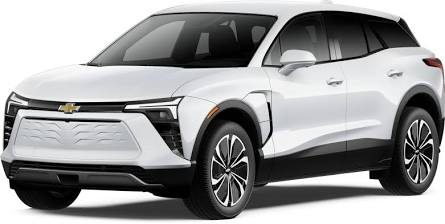
Chevrolet’s rollout of its Ultium platform encountered early software hurdles, but the current production vehicle has emerged as a formidable option for buyers transitioning out of traditional internal combustion midsize SUVs. The Blazer EV is large, bold, and heavily optimized for the realities of American road-tripping and family hauling.
| Specification | 2026 Chevrolet Blazer EV |
|---|---|
| Starting MSRP | $44,700 (LT FWD) |
| Tested Trim Price | $44,700 (LT FWD) |
| Powertrain | Single-Motor Front-Wheel Drive (FWD) |
| Horsepower | 220 hp |
| Battery Capacity | 85.0 kWh (usable) |
| EPA Estimated Range | 312 Miles (FWD Variants) |
| Peak DC Fast Charging Rate | 150 kW |
| DC Fast Charging Time | 20% to 80% in Approximately 35 Minutes |
Road Manners & Real-World Commuting
The Blazer EV handles like a heavy luxury crossover. Its substantial weight provides a planted feel on the highway, steamrolling pavement seams and expansion joints with absolute authority. General Motors engineered this platform with a low center of gravity by mounting the battery pack flat between the axles, keeping body roll remarkably well checked during cornering.
The standard front-wheel-drive LT trim produces 220 horsepower, which provides smooth, unhurried acceleration. It won’t snap your neck off the line like a Tesla, but it has plenty of mid-range punch for passing maneuvers at 70 mph. The cabin remains quiet at speed, isolated from tire roar even when riding on the large 19-inch wheels.
Cabin Volume and Utility
This is where the Blazer EV claims its ground against the Ioniq 5 and Model 3. The interior feels spacious, offering a wide cabin layout that gives passengers plenty of shoulder room. Rear-seat legroom is a spacious 38.9 inches, and the rear floor is completely flat, making the center seat fully usable for adults.
| Vehicle | Cargo Capacity (Seats Up) | Cargo Capacity (Seats Folded) |
|---|---|---|
| 2026 Chevrolet Blazer EV | 25.5 cu ft | 59.1 cu ft |
| 2026 Hyundai IONIQ 5 | 27.2 cu ft | 59.3 cu ft |
| 2026 Tesla Model 3* | 21.0 cu ft | 42.1 cu ft |
| Rank | Vehicle | Seats Up | Seats Folded |
|---|---|---|---|
| 🥇 | Hyundai IONIQ 5 | 27.2 cu ft | 59.3 cu ft |
| 🥈 | Chevrolet Blazer EV | 25.5 cu ft | 59.1 cu ft |
| 🥉 | Tesla Model 3 | 21.0 cu ft | 42.1 cu ft |
The rear cargo floor is low and wide, making it easy to slide in heavy grocery boxes or strollers. Note that General Motors chose not to include a front trunk on the Blazer EV; the space under the hood is entirely occupied by power electronics, climate control hardware, and structural bracing.
Google Built-In and Driver-Assistance Features
Chevrolet made a highly publicized decision to eliminate Apple CarPlay and Android Auto compatibility, opting instead for a native infotainment system developed in partnership with Google. The standard 17.7-inch central touchscreen is stunning, sharp, and fast. Google Maps handles navigation directly, incorporating accurate charger routing and real-time state-of-charge predictions upon arrival.
While the system works well, forcing buyers to rely on native applications or bluetooth streaming rather than mirroring their smartphones remains a clear drawback for tech-focused consumers. On the driver-assistance side, GM’s Super Cruise hands-free driving system is available on select configurations, providing excellent lane-keeping and speed management on over 400,000 miles of mapped North American highways.
Charging Characteristics & Battery Longevity
The Blazer EV LT runs on a 400-volt architecture and tops out at a 150 kW DC fast charging rate. Because the battery pack is large, its charging curve requires a more patient approach than the competition.
A stop at a public fast charger to go from 20% to 80% requires roughly 35 minutes. If you regularly complete long interstate journeys, this longer stop is something to keep in mind compared to the quick pauses required by the Hyundai E-GMP vehicles.
For home charging, the Blazer EV features an 11.5 kW onboard charger. If your garage is wired for a 60-amp circuit delivering 48 amps clean, you can fully replenish the battery from flat in about 8.5 hours.
4. Kia EV6: The Driver’s Crossover
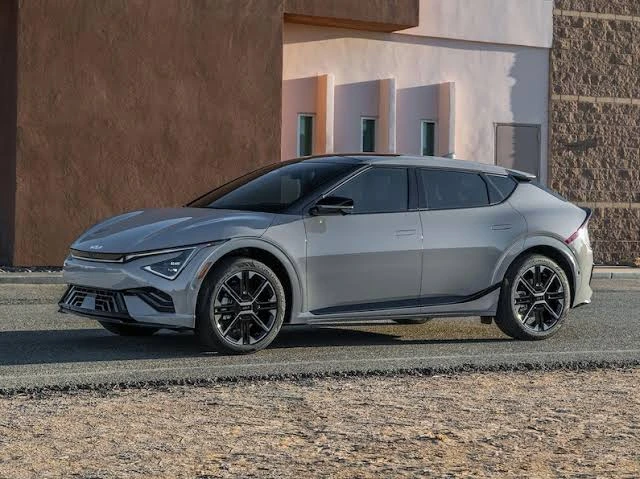
Sharing the same underlying E-GMP bones as the Hyundai Ioniq 5, the Kia EV6 takes a fundamentally different approach to its styling and chassis tuning. While its sibling prioritizes a loft-like cabin atmosphere and a compliant ride, the EV6 lowers its roofline, sharpens its damper rates, and positions itself as a driver’s tool disguised as a family hatchback.
| Specification | 2026 Kia EV6 |
|---|---|
| Starting MSRP | $39,445 (Light RWD) |
| Tested Trim Price | $44,500 (Wind RWD) |
| Powertrain | Single-Motor Rear-Wheel Drive (RWD) |
| Horsepower | 225 hp |
| Torque | 258 lb-ft |
| Battery Capacity | 84.0 kWh (Wind Trim) |
| EPA Estimated Range | 319 Miles (Wind RWD) |
| Peak DC Fast Charging Rate | 240 kW |
| DC Fast Charging Time | 10% to 80% in Approximately 18 Minutes |
| Metric | Value |
|---|---|
| Model | 2026 Kia EV6 |
| Starting Price | $39,445 |
| Tested Price | $44,500 |
| Drive Layout | RWD |
| Motor Configuration | Single Electric Motor |
| Output | 225 hp / 258 lb-ft |
| Battery | 84.0 kWh |
| EPA Range | 319 Miles |
| Max DC Charging | 240 kW |
| Charge Time (10–80%) | 18 Minutes |
Handling & Performance Profiling
From the moment you turn the wheel, the EV6 feels tauter than the Ioniq 5. The suspension calibration uses firmer rebound damping, minimizing body lean through quick corners and keeping the chassis settled over mid-corner pavement transitions. The steering has a meatier weight to it, communicating changes in front-wheel grip with more clarity than its Hyundai stablemate.
The Wind RWD model utilizes the same 225-horsepower motor mounted on the rear axle. It pulls cleanly from a standstill, hitting 60 mph in 6.6 seconds. The braking system transitions smoothly between mechanical friction braking and regenerative deceleration, avoiding the wooden pedal feel that plagues many heavy electric crossovers.
Cabin Layout and Cockpit Intimacy
The EV6 interior wraps tightly around the driver. A high, floating center console separates the front seats, creating a cockpit feel that contrasts with the open floor plan of the Ioniq 5. Physical buttons are utilized effectively, featuring a switchable dynamic touch panel that alternates between climate adjustments and audio controls.
| Vehicle | Front Headroom | Rear Legroom |
|---|---|---|
| 2026 Kia EV6 | 39.0 in | 39.0 in |
| 2026 Hyundai IONIQ 5 | 39.8 in | 39.4 in |
| 2026 Chevrolet Blazer EV | 40.2 in | 38.9 in |
| Rank | Best Front Headroom | Measurement |
|---|---|---|
| 🥇 | Chevrolet Blazer EV | 40.2 in |
| 🥈 | Hyundai IONIQ 5 | 39.8 in |
| 🥉 | Kia EV6 | 39.0 in |
| Rank | Best Rear Legroom | Measurement |
|---|---|---|
| 🥇 | Hyundai IONIQ 5 | 39.4 in |
| 🥈 | Kia EV6 | 39.0 in |
| 🥉 | Chevrolet Blazer EV | 38.9 in |
The lower roofline cuts into rear headroom for passengers over six-foot-two, and the smaller rear window limits rear visibility. Cargo volume is slightly tighter than the Blazer and Hyundai, checking in at 24.4 cubic feet with the rear seats up and 50.2 cubic feet with them folded flat.
Charging Performance & Thermal Control
Because it shares Hyundai’s 800-volt architecture, the EV6 matches the best-in-class 18-minute 10-to-80 percent charging speed at 350 kW stations. Its thermal management system is highly efficient, pulling waste heat from the electric motors to help warm the cabin in cold weather.
On winter road trips, battery pre-conditioning works efficiently to keep charging speeds high, provided you use the integrated navigation system to route to your next charging stop.
Market Dynamics & The Total Cost of Ownership
Choosing an electric car under $50,000 requires looking past the window sticker to understand how manufacturing locations, battery chemistry, and dealer inventories interact to affect your actual monthly budget.
| Vehicle Model | Starting MSRP | Final Assembly Location | OBBBA Interest Deduction | Real-World Range (70 MPH Summer) | Real-World Range (30°F Winter) |
| Hyundai Ioniq 5 (SEL) | $39,800 | United States (Georgia) | Eligible | 290 Miles | 215 Miles |
| Tesla Model 3 (LR AWD) | $47,490 | United States (California) | Eligible | 315 Miles | 260 Miles |
| Chevrolet Blazer EV (LT) | $44,700 | United States (Michigan) | Eligible | 295 Miles | 220 Miles |
| Kia EV6 (Wind RWD) | $44,500 | South Korea | Ineligible | 295 Miles | 210 Miles |
The Financing Reality: Why VINs Matter
The regulatory landscape in 2026 makes the country of origin critical for your wallet. Under the current OBBBA tax guidelines, vehicles manufactured in North America allow buyers to treat their auto loan interest as a direct “above-the-line” tax deduction.
On a $45,000 auto loan structured over 60 months at a 6.5% interest rate, you will pay roughly $7,800 in total interest charges. For an eligible buyer in the 22% federal tax bracket, deducting that interest saves over $1,700 in real money over the course of the loan.
Because the Kia EV6 is currently assembled in South Korea, its VIN excludes it from this financing advantage. Kia dealerships frequently counter this by rolling equivalent factory cash incentives into consumer lease structures. However, if you prefer traditional ownership through a vehicle purchase, the domestic options offer a built-in financial advantage.
Maintenance and Insurance Forecasts
Data from fleet operators indicates that scheduled maintenance costs for all four vehicles run approximately 40% lower than an equivalent internal combustion SUV over the first 50,000 miles. You can skip engine oil changes, spark plug replacements, and traditional transmission flushes entirely. Your ongoing mechanical maintenance is largely limited to cabin air filter swaps, tire rotations, and topping off windshield washer fluid.
Insurance costs require careful budgeting. EVs carry higher premiums than internal combustion vehicles due to specialized repair techniques and high battery replacement costs following a collision. Expect insurance premiums to run 15% to 25% higher than a gas-powered crossover of similar value. The Tesla Model 3 often carries the highest insurance rates of this group due to proprietary structural repair requirements and higher average claims payouts.
Depreciation Realities
Depreciation patterns for electric vehicles have stabilized after several volatile years. Vehicles with active thermal management and robust charging speeds hold their residual value predictably.
The Ioniq 5 and Model 3 are currently projected to retain roughly 46% to 48% of their original value after a 5-year/60,000-mile ownership cycle. This matches the broader market performance of premium internal combustion sedans and crossovers.
FAQ Section
How much driving range do these electric cars lose during cold winter months?
Real-world winter testing demonstrates that most modern EVs experience an efficiency drop of 20% to 30% when temperatures hover near freezing ($32^\circ\text{F}$ or $0^\circ\text{C}$). This loss stems from running the cabin heater and the increased energy required to keep the battery pack within its optimal operating temperature window. Models equipped with an integrated heat pump—such as the Tesla Model 3 and Hyundai Ioniq 5—minimize this loss, holding range reduction closer to 15% to 20% compared to vehicles relying on older resistive heating elements.
Can I plug an 800-volt EV like the Kia EV6 or Hyundai Ioniq 5 into a standard 150 kW charger?
Yes. The vehicle’s onboard power electronics feature an integrated boost-converter that raises the incoming voltage from a 400-volt station up to the battery’s native 800-volt requirement. While the car will charge safely, your charging speed will be limited by the maximum output of that specific station, usually resulting in a 10-to-80 percent charge time of approximately 25 to 30 minutes instead of the optimal 18 minutes.
What are the real-world differences between Level 1, Level 2, and DC Fast Charging?
Level 1 charging uses a standard 120V household outlet and adds roughly 3 to 5 miles of range per hour—best reserved for emergency needs or short commutes. Level 2 charging runs on a 240V circuit (similar to a clothes dryer) and adds 25 to 45 miles of range per hour, easily replenishing any EV overnight. DC Fast Charging bypasses the vehicle’s onboard charger to dump high-power direct current directly into the battery pack, adding 100 to 200 miles of range in 15 to 35 minutes during road trips.
Do I need to upgrade my home electrical panel to install a Level 2 charger?
Not necessarily. Most modern Level 2 chargers can be adjusted to match your home’s available electrical capacity. While a dedicated 60-amp circuit allows the vehicle to pull its maximum charge rate (usually 11.5 kW), you can easily configure a charger to run safely on a more modest 30-amp or 40-amp circuit. This provides plenty of speed to completely charge the vehicle overnight without requiring an expensive home electrical service panel upgrade.
How many years are these electric car battery packs expected to last before needing replacement?
Federal regulations require all auto manufacturers to provide a minimum 8-year/100,000-mile warranty on all electric vehicle battery packs, guaranteeing they retain at least 70% of their original capacity. Real-world fleet data indicates that modern liquid-cooled lithium-ion batteries degrade slowly, typically losing only 1% to 1.5% of total capacity per year. This means the battery pack is engineered to outlast the useful life of the vehicle chassis itself.
Final Verdict
Choosing the right EV under $50,000 comes down to analyzing your specific lifestyle, driving patterns, and home charging setup. None of these four options represent a bad financial move, but each addresses a completely different type of driver.
The Holistic Champion: Hyundai Ioniq 5
If you want the most versatile, fastest-charging, and complete daily driver on the market, spend your money on the Hyundai Ioniq 5. Its 800-volt charging speed removes the friction from road-tripping, its cabin layout is a lesson in everyday ergonomics, and its shift to domestic U.S. manufacturing makes it a smart financing play under the OBBBA tax guidelines. It balances family comfort with advanced technology better than anything else in its price bracket.
- Biggest Strengths: Best-in-class 18-minute DC charging; expansive, open interior layout; smooth ride compliance.
- Biggest Weaknesses: Raked rear glass cuts into tall cargo boxes; minimalist front trunk space.
- Best Buyer Profile: Suburban families, tech adopters, and road-trippers who want to minimize time spent at public charging plazas.
The Efficiency Standard: Tesla Model 3
For long-distance commuters who prioritize energy efficiency, structural handling refinement, and integrated public charging networks, the Tesla Model 3 Long Range AWD remains an excellent choice. It drives with an agility that heavy crossovers can’t match and squeezed the most real-world range out of every kilowatt-hour of battery capacity.
- Biggest Strengths: Supercharger integration; excellent cold-weather efficiency; quiet highway ride.
- Biggest Weaknesses: Polarizing turn-signal buttons and touchscreen gear shifting; narrow trunk opening.
- Best Buyer Profile: Daily long-distance commuters, single professionals, and efficiency purists who want a focused driving tool.
The Spacious Traditionalist: Chevrolet Blazer EV
If you are transitioning directly out of a midsize gas SUV and refuse to compromise on a commanding driving position, large cargo capacity, and a traditional domestic feel, buy the Chevrolet Blazer EV. It handles broken pavement with absolute authority and offers a roomy cabin layout for growing families.
- Biggest Strengths: Substantial cargo volume; comfortable highway ride; great Google Maps integration.
- Biggest Weaknesses: Lack of Apple CarPlay/Android Auto; slower 400-volt charging curve; heavy curb weight.
- Best Buyer Profile: Family buyers moving out of traditional midsize gas crossovers who need maximum interior volume.
The Enthusiast’s Option: Kia EV6
If you like the mechanical advantages of the Hyundai platform but want a sharper, more driver-focused package with a traditional cockpit feel, the Kia EV6 deserves a spot on your shortlist. Just keep in mind that its imported assembly status requires careful negotiation with your dealer to unlock lease-based incentives that balance out its lack of direct OBBBA tax interest deductions.
- Biggest Strengths: Agile handling dynamics; rapid 800-volt charging; driver-focused interior design.
- Biggest Weaknesses: Compromised rear visibility; limited rear headroom; misses out on direct OBBBA interest write-offs.
- Best Buyer Profile: Drivers who want an electric vehicle that prioritizes cornering dynamics and sporty design over maximum utility.