

Best Electric SUVs Under $50k : If you look closely at American driving habits, the traditional sedan has effectively become a niche product. The real battle for driveways across the United States is being fought in the compact and midsize utility segments. Families want sitting-high visibility, a commanding view of the road, and the ability to throw a mountain bike or a week’s worth of big-box store groceries into the back without playing a game of Tetris.
What’s interesting here is that while the sedan market offers extreme efficiency, the market for the best electric suvs under 50k is where manufacturers are throwing their heaviest engineering dollars. They are trying to solve a tough engineering riddle: how do you give American buyers the boxy, high-riding utility they demand without creating a brick-shaped aerodynamic disaster that destroys highway driving range?
The real story isn’t the total battery capacity or the size of the digital screens plastered across the dashboards. It’s how these crossovers handle the realities of daily family hauling—school drop-off lanes, sudden weekend rainstorms, cramped parking garages, and long interstate road trips where kids are counting down the minutes between charging stops. If an electric SUV looks great on a showroom floor but forces you to sit at a dark public charging station for 50 minutes with a car full of restless passengers, it fails the basic test of utility.
Defining the Contenders: Real-World Utility and Family Dynamics
When we filter the current U.S. automotive market for utility vehicles carrying an MSRP below the $50,000 mark, three distinct philosophies emerge. We evaluated the segment-defining heavyweights to see how their engineering choices translate to actual ownership experiences.
Best Electric SUVs Under $50k Landscape: Performance & Packaging Comparison
| Vehicle | Horsepower | Cargo Capacity | Wheelbase |
|---|---|---|---|
| 2026 Hyundai IONIQ 5 SEL RWD | 225 hp | 27.2 cu ft | 118.1 in |
| 2026 Chevrolet Blazer EV LT FWD | 220 hp | 25.5 cu ft | 121.8 in |
| 2026 Ford Mustang Mach-E Select | 266 hp | 29.7 cu ft | 117.5 in |
Quick Specs Snapshot
| Model | Power Output | Cargo Space | Wheelbase |
|---|---|---|---|
| Hyundai IONIQ 5 SEL RWD | 225 hp | 27.2 cu ft | 118.1 in |
| Chevrolet Blazer EV LT FWD | 220 hp | 25.5 cu ft | 121.8 in |
| Ford Mustang Mach-E Select | 266 hp | 29.7 cu ft | 117.5 in |
Category Leaders
| Category | Winner | Figure |
|---|---|---|
| 🏆 Highest Horsepower | Ford Mustang Mach-E Select | 266 hp |
| 🏆 Largest Cargo Area | Ford Mustang Mach-E Select | 29.7 cu ft |
| 🏆 Longest Wheelbase | Chevrolet Blazer EV LT FWD | 121.8 in |
1. Hyundai Ioniq 5: The Space-Efficiency King
The Hyundai Ioniq 5 challenges our traditional definition of an SUV shape. While its retro-futuristic, geometric lines make it look like a hatchback in pictures, standing next to it reveals its true scale.
Cabin Ergonomics and Family Duty
Hyundai pushed the wheels to the absolute corners of the vehicle, creating a massive 118.1-inch wheelbase that rivals full-size luxury three-row vehicles. For a family, this architecture pays massive dividends. The floor is entirely flat, giving kids in the back row uncompromised foot room.
The rear seats slide backward and forward on tracks, allowing you to prioritize either class-leading legroom or extra cargo depth depending on the day’s chores. Rear side-window sunshades and dedicated B-pillar air vents keep kids comfortable on hot summer days, preventing the cabin from becoming an oven.
Cargo Realities
Behind the second row, you get a wide, easily accessible 27.2 cubic feet of storage. Fold the rear seats flat, and that volume swells to 59.3 cubic feet.
The load floor is relatively flush with the rear bumper opening, making it easy to slide heavy coolers or strollers inside without straining your back. Up front, there is a small storage compartment under the hood, but it is purely intended for charging cables or dirty items you want to keep out of the main cabin.
2. Chevrolet Blazer EV: The American Road Cruiser
General Motors built the Blazer EV on its heavy-duty Ultium platform, and it feels every bit like a traditional, substantial American midsize crossover.
Ride Execution and Commuting Comfort
The Blazer EV handles with a planted, heavy-car stability that shields passengers from the outside world. It tracks straight on the highway with minimal steering corrections, acting as an excellent long-distance cruiser.
Acoustic insulation is top-tier; GM engineers successfully isolated the cabin from the high-frequency motor hum and wind whistle that often plague boxier SUVs at 70 mph. The front seats are wide and plush, accommodating a wide variety of body types comfortably over multi-hour stints.
Cabin and Cargo Packaging
The Blazer EV utilizes its footprint to provide an exceptionally wide cabin. Passengers don’t feel like they are rubbing elbows, and the center console offers massive storage bins for purses, tablets, and road-trip snacks.
Rear legroom is generous at 38.9 inches, and the seatback angles are relaxed. Cargo capacity sits at 25.5 cubic feet with all seats upright, expanding to 59.1 cubic feet with the second row dropped.
The lack of a front trunk is a minor annoyance, as the entire space under the hood is filled with the mechanical components of the climate control system and power electronics.
3. Ford Mustang Mach-E: The Athletic Packhorse
The Ford Mustang Mach-E takes a decidedly sporty approach to the family SUV formula. It trades a bit of ride softness for crisp handling, a low roofline silhouette, and clever storage solutions.
Ford Mustang Mach-E Dynamic Profile
| Driving Characteristic | Assessment |
|---|---|
| Steering Response | Taut & Direct |
| Suspension Setup | Firmer / Controlled |
| Cargo Versatility | Deep Frunk / Drainable Front Storage |
| Category | Character |
|---|---|
| Steering Feel | Responsive and confidence-inspiring |
| Ride Quality | Sportier than most mainstream electric SUVs |
| Cornering Behavior | Composed with limited body roll |
| Highway Stability | Strong, planted feel |
| Practicality | Enhanced by front trunk and flexible cargo area |
| Attribute | Description |
|---|---|
| Steering Response | The Mach-E delivers quick turn-in and a more connected feel than many EV crossovers, making it appealing to drivers who value engagement behind the wheel. |
| Suspension Tuning | Firmer damping helps improve handling precision, though rough pavement can feel more noticeable compared with comfort-focused rivals like the IONIQ 5. |
| Cargo Innovation | Ford’s drainable front trunk (frunk) adds genuine utility, functioning as a storage compartment, cooler, or tailgating accessory space. |
Driving Character and Cabin Vibe
The Mach-E features a firmer suspension tune than the Hyundai or Chevrolet. It corners with very little body roll, giving the driver plenty of confidence on twisting country roads or tight highway cloverleafs. The downside is a ride that can feel busy over choppy urban pavement or deep potholes, transmitting vertical impacts into the cabin more noticeably than its smoother rivals.
Inside, the vertical 15.5-inch Sync 4A touchscreen dominates the dashboard. The system features a large physical volume knob cut directly into the glass, offering a welcome tactile anchor for basic adjustments while driving.
Cargo Innovation
The Mach-E punches above its weight in pure storage metrics, offering 29.7 cubic feet behind the rear seats and 59.7 cubic feet with them folded flat. Because of its fastback sloping rear hatch, hauling exceptionally tall or boxy appliances can be a challenge.
Ford completely dominates the front trunk game here, providing a 4.7-cubic-foot “frunk” that is fully lined in durable plastic and features a built-in drain plug at the bottom. You can line it with ice and use it as a cooler for tailgating, or throw muddy hiking boots inside and simply hose it out afterward.
Charging Curves, Winter Degradation, and Thermal Reality
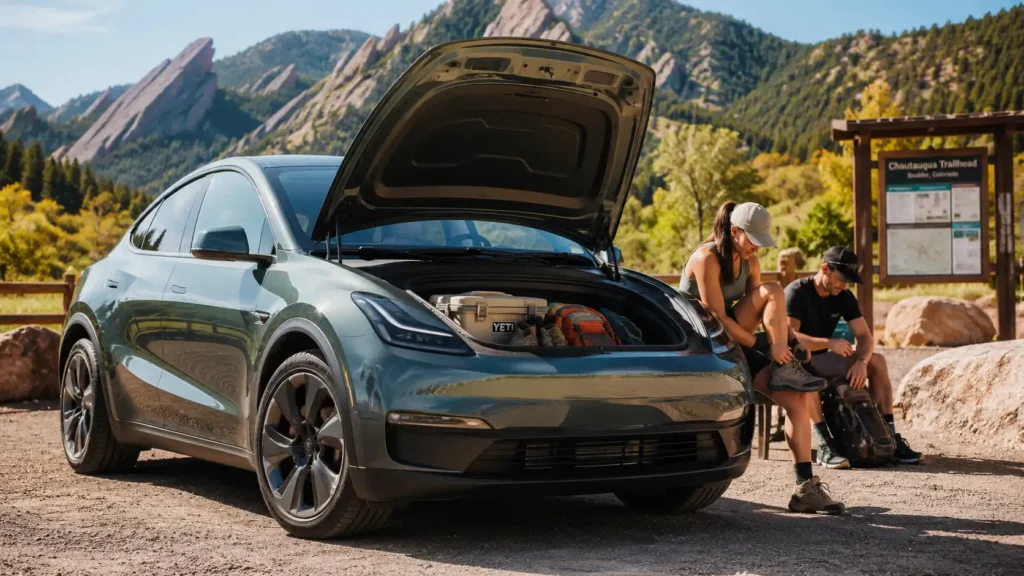
When choosing an electric SUV for family duties, how fast the vehicle charges matters just as much as its maximum range. A road trip with kids requires predictable, rapid charging stops to keep everyone happy.
| Vehicle | DC Fast Charging (10% to 80% SoC) |
|---|---|
| Hyundai Ioniq 5 | 18 Minutes (Peak 240 kW) |
| Ford Mustang Mach-E | 32 Minutes (Peak 150 kW) |
| Chevrolet Blazer EV | 35 Minutes (Peak 150 kW) |
The Hyundai Ioniq 5 holds an undeniable technical advantage thanks to its native 800-volt architecture. If you plug into a 350 kW DC fast-charging station, the vehicle can pull a peak rate of 240 kW, maintaining speeds above 150 kW deep into its charging cycle. This means you can stretch your legs, use the restroom, grab a snack, and head back out on the highway in just 18 minutes.
The Ford Mustang Mach-E and Chevrolet Blazer EV rely on traditional 400-volt architectures, topping out at 150 kW. Their internal computer systems taper charging speeds much sooner to protect battery health. A typical 10-to-80 percent charging stop in the Ford or Chevy will take between 32 and 35 minutes. Over a long road trip requiring multiple stops, that time difference adds up quickly.
FAQ Section
Can these electric SUVs tow a trailer or a camper?
Yes, but with limitations. The Hyundai Ioniq 5 is rated to tow up to 2,300 pounds when properly equipped with a braked trailer, which is plenty for a small utility trailer or jet skis. The Ford Mustang Mach-E is not officially rated for towing in the United States, though European models carry a modest rating. Keep in mind that towing anything heavy creates massive aerodynamic drag, which will easily slice your real-world driving range in half.
Do these SUVs come standard with All-Wheel Drive (AWD)?
No. To keep the base starting prices under the $50,000 threshold, most entry-level trims utilize a single-motor configuration spinning either the front or rear wheels. Opting for a dual-motor All-Wheel Drive system generally adds between $3,000 and $4,500 to the MSRP, increases total horsepower and foul-weather traction, but drops your total EPA estimated driving range by 15 to 25 miles per charge.
How do child safety seats fit in the back row of these crossovers?
All three vehicles feature easily accessible LATCH anchor points buried within the rear seat creases. Thanks to the long wheelbases typical of dedicated EV platforms, installing rear-facing infant seats is a breeze. Front passengers won’t have to slide their seats forward uncomfortably to accommodate the shell of a rear-facing child seat, a common pain point in traditional gas-powered compact SUVs.
Is it safe to drive these electric SUVs through automatic car washes?
Absolutely. Electric vehicles are subjected to rigorous high-pressure water testing during manufacturing to ensure all high-voltage electronics, battery enclosures, and charging ports are completely sealed against the elements. You can run them through standard automatic car washes or use high-pressure spray wands without any risk of electrical malfunction.
Final Verdict: Which is the Best Electric SUV Under $50k?
If you are shopping the under-$50,000 SUV segment for a dependable family hauler, your choice should match your daily driving environment and family road-trip frequency.
- Buy the Hyundai Ioniq 5 if you want the absolute best all-around package. Its combination of slides-on-tracks rear seating, incredible 800-volt fast-charging speeds, and open cabin design makes it the most liveable option on the market today.
- Buy the Chevrolet Blazer EV if you want a traditional, heavy-set midsize footprint. It excels at smoothing out broken pavement and offers a wide, isolated cabin that feels familiar to anyone coming out of a traditional gas-powered crossover.
- Buy the Ford Mustang Mach-E if you want a sporty driving experience and clever storage solutions. Its firm handling makes it fun to drive, and its washable, drainable front trunk is an unmatched utility tool for outdoorsy families.
Also Read This:
Best Electric Cars Under $50,000 for 2026: Real-World Range, Charging, and Value Compared