
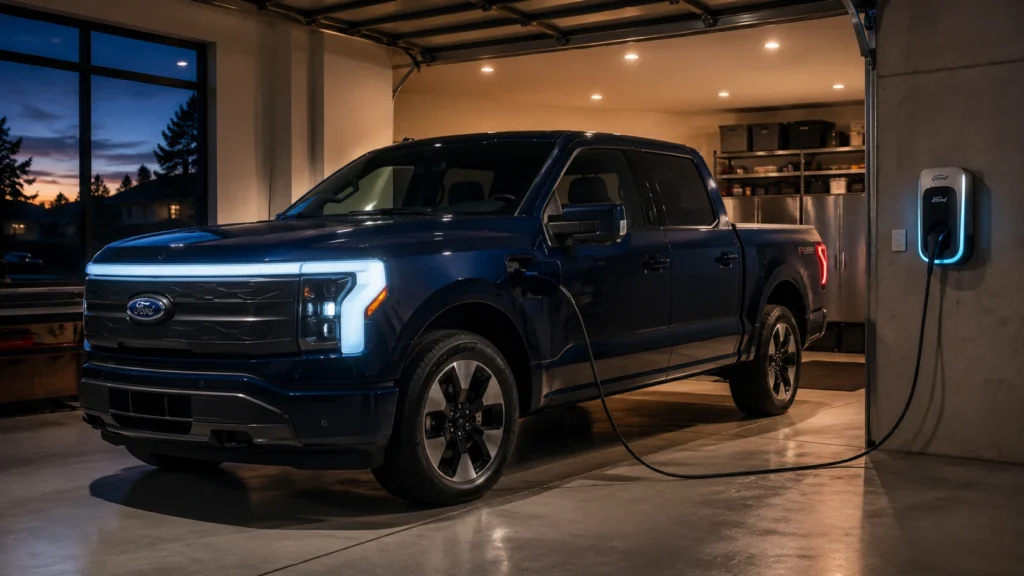
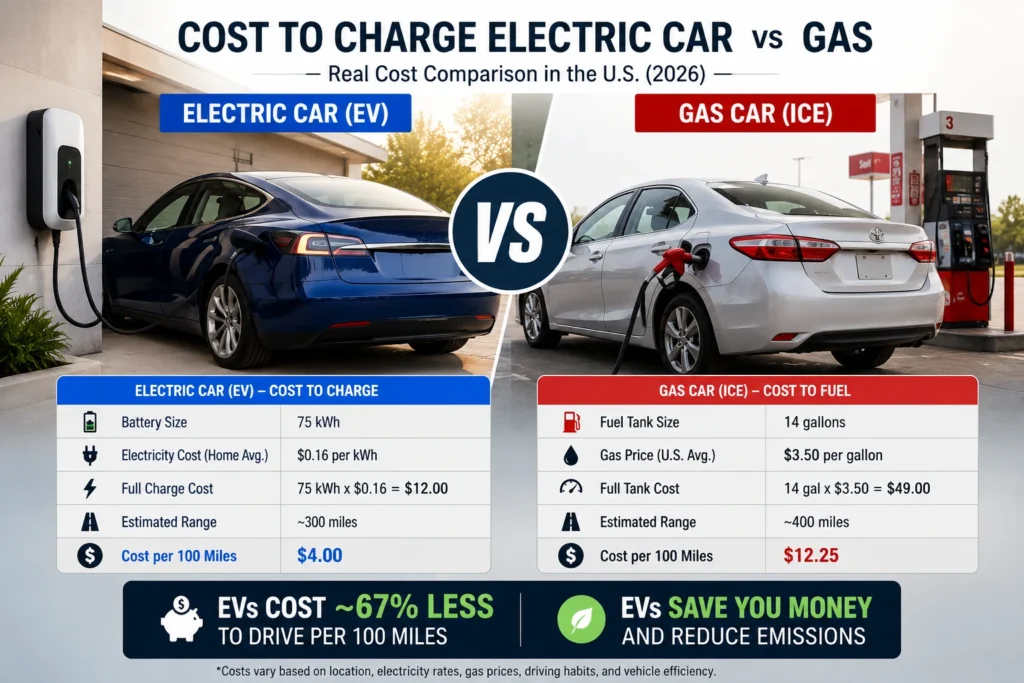
When analyzing the cost to charge electric car vs gas, fuel expenses in 2026 heavily favor home electric charging over traditional gas. Powering an electric vehicle at home averages 4.5 cents per mile, compared to 17 cents per mile for a standard gasoline vehicle. However, relying exclusively on public fast chargers completely erases this financial advantage.
Introduction
The simple act of refueling a personal vehicle has undergone a massive paradigm shift over the last few years. American drivers are no longer tethered solely to the neighborhood gas station corner. Instead, an increasingly electrified grid provides multiple options for replenishment.
This newfound freedom introduces complex layers of financial calculation that can puzzle even tech-savvy shoppers. With regular unleaded fuel prices demonstrating continuous volatility across the country, calculating long-term operational costs requires modern metrics.
Many buyers jump into the alternative powertrain segment expecting immediate, unmitigated reductions in their daily transportation overhead. They look forward to bypassing digital pump screens and ignoring global oil supply disruptions.
Yet, real-world operation reveals a more nuanced truth about everyday utility bills and infrastructure fees. The exact location where you replenish your vehicle determines whether you save thousands or break even.
To truly understand the modern energy balance, we must contrast cents per kilowatt-hour with dollars per gallon. Let’s analyze the precise mechanics of utility rate sheets, commercial station surcharges, and real-world thermal efficiency.
Quick Answer Section
If you possess a dedicated home charging setup, an electric vehicle represents a major financial victory. At current national averages, home charging costs about one-third the price of regular gasoline for equivalent distances.
Conversely, drivers who must rely strictly on commercial public fast-charging networks will discover near-parity with gas expenses. Public charging fees can quickly match or surpass the cost of fueling a standard combustion vehicle on long highway commutes.
Recommended Tool: Department of Energy Alternative Fuels Data Center Vehicle Cost Calculator
Why: This comprehensive tool enables drivers to input localized utility rates and regional fuel costs to receive an individualized total cost comparison.
Key Takeaways
- The Home Power Advantage: Charging a battery at home overnight delivers an equivalent fuel cost of roughly $1.35 to $1.50 per gallon.
- The Public Charging Penalty: Utilizing commercial DC fast chargers raises your per-mile operational expense to nearly 16.5 cents, matching internal combustion.
- The Break-Even Mileage: Standard commuters must log approximately 6,000 miles annually via home power to offset initial charging hardware installations.
- Regional Electric Variance: Coastal states like California feature residential electric rates that double the costs found in midwestern states.
- The Segment Efficiency Delta: Electric trucks and large SUVs consume significantly more energy per mile, widening the financial gap against gas models.
- Thermal Efficiency Realities: Freezing winter climates can degrade battery range by up to 30%, temporarily increasing seasonal charging costs.
Analyzing the Cost to Charge Electric Car vs Gas
The Macroeconomic Reality of Modern Underwriting
Energy markets operate on complex supply dynamics that directly dictate what consumers pay at the point of consumption. Petroleum relies on international extraction pipelines, global refining capacities, and localized regional fuel taxes.
Electricity depends entirely on regional power grids, local infrastructure updates, and diverse generating assets like natural gas and renewables. These fundamentally distinct supply chains create diverging pricing patterns across the United States.
While gasoline exhibits sudden, unpredictable spikes driven by geopolitical volatility, electrical power structures move slowly. This relative stability allows commuters to forecast their monthly transportation budgets with exceptional accuracy.
Understanding the underlying mechanics of these energy platforms is essential for calculating true total cost of ownership metrics. Let’s explore how raw energy values convert into real-world highway miles.
Decoding the Math: Gallons vs. Kilowatt-Hours
To establish a level playing field, we must translate two entirely different physical units of energy measurement. Gasoline vehicles measure consumption using miles per gallon, a metric refined over a century of traditional automotive travel.
Electric platforms utilize kilowatt-hours per 100 miles, tracking the raw electricity drawn from a battery pack. One gallon of standard regular gasoline contains the thermal energy equivalent of approximately 33.7 kilowatt-hours of electricity.
However, internal combustion engines are notoriously inefficient, wasting roughly 70% to 80% of their fuel’s energy as ambient heat. Electric drivetrains operate at over 85% efficiency, converting nearly all incoming electrical current into forward momentum.
This massive difference in thermodynamic efficiency forms the foundation of why electric platforms require less raw energy input. An electric vehicle can travel three to four times farther on the exact same energy equivalent as a gas car.
Therefore, even when local electricity costs seem elevated, the superior mechanical efficiency of the vehicle protects your wallet. Let’s look at how these engineering dynamics manifest at the residential power meter.
The True Cost of Home Charging
Analyzing the Residential Utility Bill
Residential electricity remains the most economical resource for alternative-fuel vehicle operation across the United States. The current national average for residential power hovers around 18.05 cents per kilowatt-hour.
A typical modern electric crossover requires roughly 30 kilowatt-hours to travel a distance of 100 highway miles. Multiplying these factors reveals that covering 100 miles costs an accessible $5.41 in electricity.
For comparison, a standard gasoline-powered crossover achieving 25 MPG requires four gallons of fuel to cover that same distance. With regular unleaded averaging $4.26 per gallon, the gas car demands $17.04 for the trip.
This means every 100 miles driven via home-charging puts more than $11 back into your household operational budget. Over a standard annual driving distance of 12,000 miles, that baseline delta compounds into substantial savings.
Owners can maximize this advantage by enrolling in specialized time-of-use utility programs offered by regional electrical providers. These plans drop overnight power rates significantly, unlocking even greater operational margins for diligent commuters.
Factoring in Equipment Installation Overhead
While recurring home electricity fees are low, unlocking Level 2 speed demands upfront infrastructure investments. Standard household 120-volt outlets are inadequate, providing only three to five miles of driving range per hour of connectivity.
Upgrading to a 240-volt Level 2 home charging station requires purchasing dedicated hardware and securing professional installation. A premium wall-mounted unit from trusted brands like ChargePoint or Wallbox carries a retail price of $450 to $700.
Hiring a certified electrician to install the necessary high-amperage circuit breaker and pull heavy-gauge wire introduces variable costs. If your existing electrical panel possesses sufficient capacity, simple installation charges range from $400 to $900.
However, older homes featuring obsolete 100-amp service panels frequently require a complete system upgrade to satisfy code mandates. Upgrading a main electrical panel to a modern 200-amp configuration can instantly add $1,500 to $3,000 to the setup expense.
Smart buyers must amortize these introductory structural costs over a multi-year ownership cycle to determine true long-term savings. Fortunately, select state incentives and federal tax credits help soften these introductory infrastructure financial requirements.
The Reality of Public DC Fast Charging Surcharges
Commercial Network Infrastructure Surcharges
The financial equation changes dramatically the moment an owner connects to a high-output public charging station. Commercial networks like Electrify America, EVgo, and the Tesla Supercharger network must recover massive capital infrastructure expenditures.
These networks face steep demand charges from local utility companies for drawing immense amounts of power during peak hours. Consequently, commercial public fast-charging rates routinely range from 48 cents to 64 cents per kilowatt-hour.
Using our baseline crossover efficiency, pulling power at 55 cents per kilowatt-hour raises the cost per 100 miles to $16.50. When contrasted with the $17.04 required for a standard 25 MPG gas vehicle, the savings completely evaporate.
Furthermore, public charging stations often assess secondary idle fees or session connection charges that add friction to the transaction. These hidden operational costs can make public charging an expensive proposition for long-distance regional travel.
Relying solely on public networks also introduces significant time penalties, requiring drivers to sit for 30 minutes or more. For urban apartment dwellers without garage access, this financial and logistical hurdle can impact the overall ownership experience.
The Logistics of Highway Fast Charging Plazas
Sustaining rapid highway travel requires strategic stops at dedicated high-voltage commercial charging hubs along primary travel corridors. These plazas deliver up to 350 kilowatts of direct current, pushing energy into battery cells at incredible speeds.
While highly convenient for long highway commutes, these stations represent premium commercial experiences with associated high-tier pricing. Operating these stations requires sophisticated thermal management fluid loops and robust cooling systems to handle intense electrical stress.
The maintenance fees required to keep these heavy-duty stations operational filter directly down into user consumption matrices. Drivers must treat public charging as an occasional highway necessity rather than a baseline refueling method.
Geographic Disparities: State-by-State Energy Costs
High-Cost Regions vs. Low-Cost Paradigms
Energy pricing is highly localized, meaning your exact zip code exerts massive influence over your monthly transport ledger. Coastal regions and specific urban centers feature electricity rates that depart significantly from midwestern baselines.
In California, residential electricity rates can easily exceed 32 cents per kilowatt-hour due to structural grid challenges. At that pricing tier, home charging costs increase to $9.60 per 100 miles, narrowing the gap against gas.
Conversely, states like Washington and Louisiana benefit from abundant hydroelectric or local natural gas power generation, dropping rates below 12 cents. Drivers in these territories enjoy incredibly cheap home charging, costing less than $3.60 per 100 miles.
Gasoline prices also exhibit extreme regional variance, with West Coast states demanding premium dollars over Gulf Coast locations. When high gas prices pair with affordable local electricity, the financial justification for alternative powertrains reaches its peak.
Before signing a vehicle purchase contract, shoppers must audit their local utility rate sheets and nearby fueling stations. Assuming national averages can lead to unexpected budgetary surprises once real-world utility bills begin arriving.
Localized Grid Interconnections
State-level regulatory environments dictate how utility companies structure their consumer billing frameworks. Regions with aggressive green energy mandates often feature higher near-term infrastructure upgrade fees embedded within baseline power bills.
Understanding your local regulatory framework ensures you select the correct vehicle configuration for your specific regional geographic needs. Let’s analyze how different vehicle segments handle these energy dynamics.
Vehicle Segment Analysis: Sedans, SUVs, and Trucks
Heavy Haulers vs. Efficient Commuters
The size and weight of your chosen vehicle segment directly dictate its overall energy appetite, regardless of powertrain. A heavy vehicle requires significantly more force to overcome aerodynamic drag and rolling resistance on the highway.
Let’s examine the compact sedan segment, where vehicles like the Honda Civic and Tesla Model 3 battle for efficiency. A highly efficient gas sedan achieving 35 MPG requires $12.17 for 100 miles of highway commuting.
An efficient electric sedan consumes roughly 25 kilowatt-hours per 100 miles, translating to just $4.51 at home power rates. In this high-efficiency segment, both options are relatively affordable, but the electric variant retains a clear margin.
The delta widens substantially when analyzing the full-size pickup truck segment, where mass and brick-like aerodynamics dominate. A traditional gas truck averaging 16 MPG consumes a painful $26.62 in regular fuel over a 100-mile work journey.
An electric pickup truck like the Ford F-150 Lightning requires around 48 kilowatt-hours per 100 miles due to its sheer scale. While less efficient than an electric sedan, home charging the truck still costs just $8.66 for that same 100-mile trip.
The Impact of Climate and Real-World Conditions
The Thermodynamic Realities of Winter Performance
Actuarial and EPA test figures represent idealized laboratory environments that rarely match the chaotic realities of everyday driving. External environmental variables can temporarily degrade vehicle efficiency, altering your expected monthly energy expenditure.
Cold winter climates present a notable challenge for battery-electric platforms, as lithium-ion chemistry slows down in freezing conditions. Furthermore, generating cabin heat via electrical resistance elements or advanced heat pumps draws directly from the traction battery.
Real-world winter testing indicates that sub-freezing temperatures can cut driving range by 20% to 30% across various models. This efficiency drop means the vehicle requires more kilowatt-hours to travel the same distance, temporarily raising your charging bills.
Gas vehicles also experience fuel economy degradation in winter weather, but their engines produce abundant waste heat for the cabin. The reduction in combustion MPG typically hovers around 10% to 15%, representing a softer seasonal penalty.
Towing heavy trailers or loading roof racks creates similar efficiency penalties for both powertrains by dramatically increasing aerodynamic drag. Owners who frequently transport heavy payloads must expect their calculated operational savings to shrink during those journeys.
Comprehensive Energy Comparison Ledger
Compact Electric Sedan (Home Power)
- Average Cost Per 100 Miles: $4.51
- Equivalent Cost Per Gallon: $1.13
Compact Gas Sedan (35 MPG)
- Average Cost Per 100 Miles: $12.17
- Equivalent Cost Per Gallon: $4.26
Midsize Electric SUV (Home Power)
- Average Cost Per 100 Miles: $5.41
- Equivalent Cost Per Gallon: $1.35
Midsize Gas SUV (25 MPG)
- Average Cost Per 100 Miles: $17.04
- Equivalent Cost Per Gallon: $4.26
Midsize Electric SUV (Public Fast Charger)
- Average Cost Per 100 Miles: $16.50
- Equivalent Cost Per Gallon: $4.12
Full-Size Electric Truck (Home Power)
- Average Cost Per 100 Miles: $8.66
- Equivalent Cost Per Gallon: $2.16
Full-Size Gas Truck (16 MPG)
- Average Cost Per 100 Miles: $26.62
- Equivalent Cost Per Gallon: $4.26
Expert Analysis
The shifting financial dynamic between electrical currents and petroleum refinement is reshaping consumer purchasing strategies across America. While upfront vehicle acquisition premiums remain a factor, the continuous operational cost delta represents a major long-term advantage.
However, the automotive industry must continue addressing the high cost of public charging infrastructure to unlock broader mainstream adoption. For drivers who lack garage access, the current public charging pricing structure represents a real financial barrier.
As regional utility grids integrate more renewable energy assets, off-peak home charging rates should remain highly competitive. Diligent buyers who align their charging habits with these grid cycles will lock in the lowest possible transport costs.
Pros and Cons
Cost to Charge an Electric Car
- Pro: Exceptional financial insulation from unpredictable global oil market spikes and retail fuel station markups.
- Pro: Ability to capture deep overnight discount tiers through home utility time-of-use programs.
- Con: High initial capital outlays required for certified electrical panel upgrades and Level 2 home charging hardware.
- Con: Elevated commercial network pricing erases operational cost benefits during extended cross-country highway travel.
- Con: Significant seasonal efficiency degradation in sub-freezing winter climates increases temporary power consumption.
Fueling a Gas Car
- Pro: Highly predictable fuel costs across major vehicle segments with decades of historical trend data.
- Pro: Instant visual pricing transparency at every major highway intersection with no digital session surcharges.
- Con: Continuous exposure to volatile retail fuel pricing driven by geopolitical events and refinery maintenance.
- Con: Low thermal efficiency dictates that up to 80% of every fueling dollar is wasted as ambient heat.
- Con: Inability to refuel at home forces mandatory detours to commercial retail stations during daily commutes.
Who Should Buy An EV For Maximum Savings
Drivers who control a dedicated driveway or garage space and have affordable residential electric rates will maximize their savings. If your daily highway commute exceeds 50 miles, the operational cost difference will quickly pay off your initial hardware investments. This advantage is amplified for families who can shift their power consumption to overnight hours.
Who Should Stick With Gas For Better Budgeting
Urban apartment residents who depend completely on curbside public parking or commercial fast-charging plazas should consider staying with gas. High commercial electricity rates combined with session fees will neutralize any expected energy savings over an internal combustion car. Low-mileage drivers who travel under 4,000 miles annually will also find it difficult to justify setup costs.
Best Alternatives
For commuters trapped in the middle of these infrastructure challenges, a conventional high-MPG hybrid vehicle represents an ideal choice. Models like the Toyota Prius or Honda Accord Hybrid deliver over 50 MPG without requiring residential electrical upgrades. They provide excellent insulation from fuel price spikes while utilizing the existing nationwide gas station network. A plug-in hybrid also offers a taste of electric commuting for those with intermittent outlet access.
FAQs
Is it truly cheaper to charge an electric car than to buy gas? Yes, if you charge at home using standard residential power, traveling an equivalent distance is about one-third the cost of regular gasoline.
How much does it cost to charge an electric car at a public station? Public DC fast charging costs range from 48 to 64 cents per kilowatt-hour, matching or exceeding traditional gasoline costs.
Does charging an electric vehicle during the night save money? Many regional utility companies offer time-of-use plans that slash power costs overnight, making late-night charging highly economical.
How much does installing a home charger impact the initial financial math? A quality Level 2 home charging station plus professional electrician installation typically costs between $800 and $2,000, depending on your panel.
Does cold weather increase the cost of charging an electric car? Yes, freezing winter temperatures can temporarily reduce battery efficiency by up to 30%, meaning you need more electricity to cover the same mileage.
Why are public charging stations so much more expensive than home power? Commercial networks face high installation costs, maintenance overhead, and steep demand charges from power companies during heavy usage periods.
Do electric trucks save as much money as electric sedans compared to gas? Electric trucks save more total dollars because traditional gas trucks are highly inefficient, making the electric operational delta larger.
Can I charge an electric car using a standard 120-volt household outlet? Yes, but standard outlets add only 3 to 5 miles of range per hour, making a dedicated Level 2 setup necessary for long commutes.
Final Verdict
The financial logic of alternative powertrains depends heavily on your access to residential charging infrastructure. If you can plug in your vehicle in your own garage overnight, you will lock in massive long-term operational savings. However, if your lifestyle forces you onto commercial fast-charging networks, a standard high-MPG hybrid vehicle remains the more practical choice for your household budget.
Read This Also:
EV Insurance Cost vs Gas Car: The Hidden 2026 Premium Penalty