
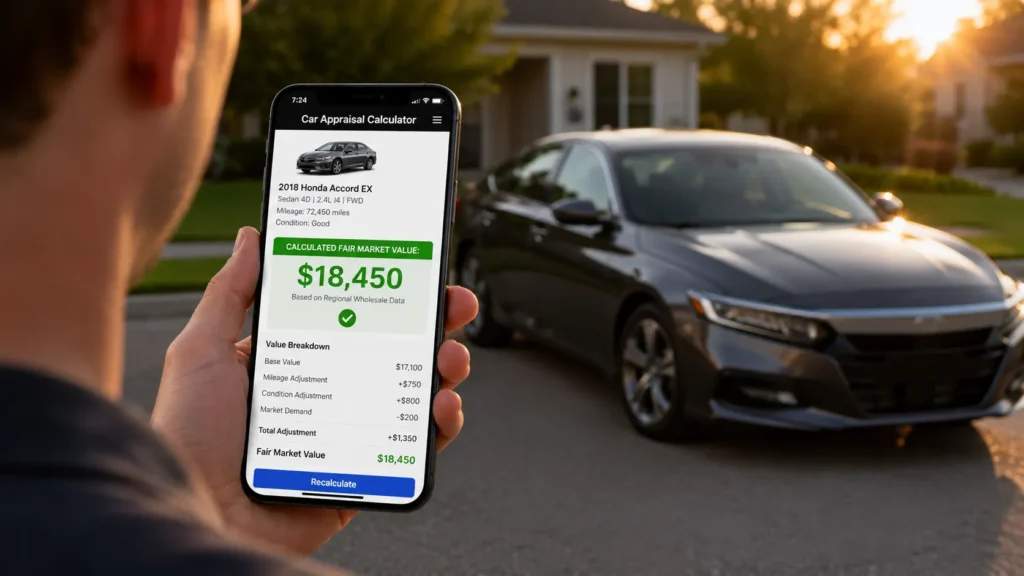
Walk into any dealership across the United States, and you will witness a familiar, tense ritual. You hand over your keys, wait 20 minutes while a used-car manager walks around your trade-in with a clipboard, and brace yourself for the initial offer. For decades, this process was a black box designed to keep consumers in the dark.
What’s interesting here is that the rise of online car appraisal calculators hasn’t completely eliminated this tension—it has just shifted the battlefield to your laptop or smartphone screen.
Today, car buyers are leaning heavily on their current vehicles to act as down payments. With new-car transaction prices holding stubborn ground near record highs, knowing the true value of your asset before talking to a salesman is your best line of defense.
The real story isn’t the software algorithm or the clean user interfaces on pricing sites. It’s how you interpret the numbers they output. On paper, getting an “instant value” sounds simple. In practice, a digital calculator is only as accurate as the regional wholesale data feeding it and the brutal honesty of the user inputting the vehicle’s condition.
Wholesale Realities: The U.S. Used Car Landscape
To use an online appraisal tool effectively, you have to understand what is happening on the ground at major wholesale auctions across America. The pre-owned market is experiencing a unique split, and your vehicle’s specific segment dictates its current market power.
For many buyers, the deciding factor in their trade-in equity comes down to powertrain and footprint size. If you are looking up the value of a fuel-efficient compact car or a used electric vehicle, market factors are currently in your favor.
Higher fuel prices nationwide have pushed wholesale buyers to aggressively bid up smaller, efficient cars. Concurrently, the used EV market has rallied significantly as dealership inventories normalize and consumer demand for affordable electric options picks up on the secondary market. On the flip side, traditional gas-powered midsize SUVs and large trucks have lagged behind the market average, meaning your appraisal for a large-footprint vehicle might come in cooler than expected.
Decoding the Big Three: KBB, Edmunds, and Carfax
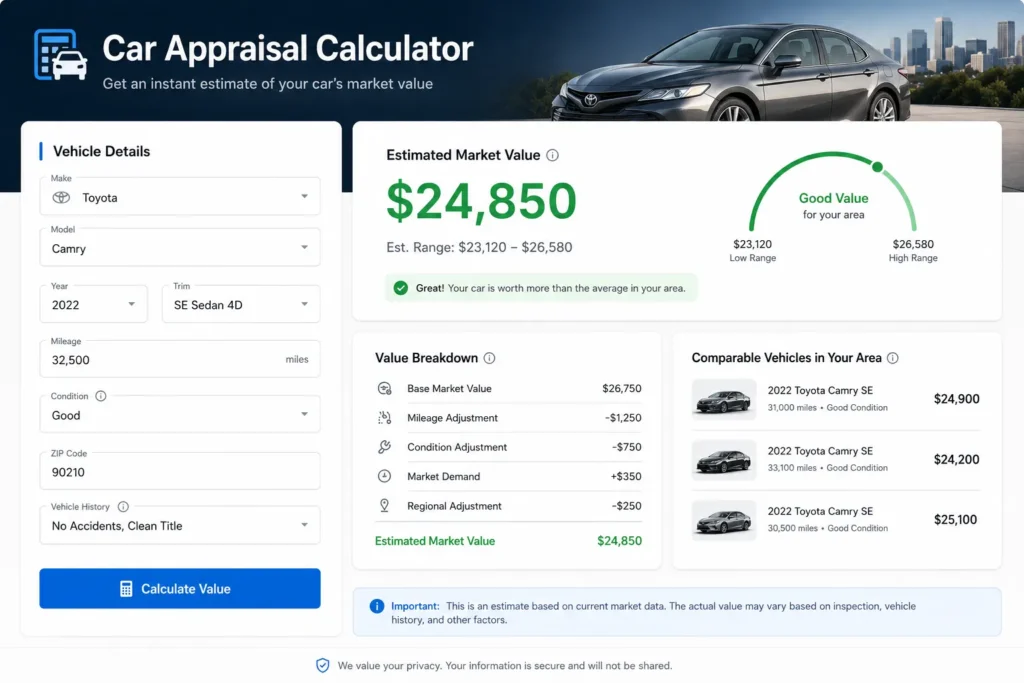
When searching for a fair market value car calculator, most buyers land on one of three foundational consumer platforms. While they all look for your VIN or license plate, their back-end methodologies differ significantly.
1. Kelley Blue Book (KBB): The Consumer Baseline
Kelley Blue Book is the historical heavyweight in the American car valuation space. KBB utilizes a proprietary algorithm that blends regional auction transactions, current retail supply and demand metrics, and seasonal macroeconomic trends to project what a car is worth.
- The Catch: KBB relies on four explicit condition tiers: Fair, Good, Very Good, and Excellent. Dealerships know that nearly 97% of consumers mistakenly label their car as “Excellent” or “Very Good”. When your online calculator printout says $20,000 based on an “Excellent” rating, but your front bumper has highway rock chips and the tires have 40,000 miles on them, a dealer will quickly drop you down to “Good” or “Fair,” slicing thousands off the trade-in offer.
2. Edmunds: The Transaction Realist
Edmunds takes a more transactional approach with its True Market Value (TMV) calculator, now often branded as the Edmunds Suggested Price. Because Edmunds operates with direct access to massive retail networks, its back-end system is integrated with high-volume, real-world retail and wholesale transaction data.
- The Catch: Edmunds downloads data weekly from the Dealer Management Systems (DMS) of roughly a quarter of all active U.S. auto dealerships. When you perform an appraisal on Edmunds, the number you receive is highly reflective of what cars are actually selling for right now in your specific zip code, rather than an idealized book value. It cuts through the fluff, presenting clear figures for trade-in, private party, and dealer retail.
3. Carfax: The History-Adjusted Calculator
Carfax approaches car valuation from a completely different angle: vehicle history. A traditional calculator asks for year, make, model, and mileage. Carfax attaches its calculator directly to the vehicle’s identification number (VIN) history report.
- The Catch: If your car has a clean title, a perfect maintenance log recorded by certified shops, and zero reported accidents, the Carfax index will often award a premium over standard book values. However, if the database flags a minor fender-bender or a missed oil-change interval from three years ago, the system will automatically dock your vehicle’s fair market value, regardless of how clean the car looks in your driveway.
Anatomy of an Appraisal: The Values Explained
When your online calculator finishes processing, it will spit out multiple numbers. Understanding the differences between these figures prevents surprises when it comes time to sign a bill of sale.
Trade-In Value
This is the amount a dealership will credit you if you hand over your vehicle and buy a new one from their inventory. It is consistently the lowest number generated by any calculator. Why? Because the dealer must absorb the cost of reconditioning the car, detailing it, advertising it, and paying commissions, all while leaving room for a wholesale or retail profit margin.
Private Party Value
This represents what you can expect to receive if you list the vehicle yourself on marketplaces like Autotrader, Facebook Marketplace, or specialized listing platforms. This figure is typically 10% to 15% higher than trade-in value. You are capturing the profit margin that a dealership would otherwise take, but you absorb the hassle of fielding phone calls, dealing with strangers, washing the car, and navigating the DMV title transfer and loan payoff paperwork yourself.
Dealer Retail Price
This is the list price you see on window stickers across dealership lots. It represents the fully reconditioned vehicle, backed by dealer administrative processing, temporary tags, and occasionally a store warranty. Never expect a dealer or private buyer to pay you this amount for your car; it is a retail target, not an acquisition price.
FAQ Section
Why does my KBB value differ so wildly from my Edmunds appraisal?
KBB and Edmunds pull from different primary data pools. KBB places heavy emphasis on broader market supply, demand formulas, and regional asking prices. Edmunds pulls direct transaction data from actual dealer management systems and high-volume retail sales logs. If a specific model is sitting on lots in your area without moving, Edmunds will reflect that downward trend faster than KBB’s broader index formula.
Does an “Instant Cash Offer” online mean a dealer has to give me that exact amount?
No. An online instant cash offer is a conditional estimate based entirely on the information you submitted. When you bring the vehicle to a participating dealership to redeem the offer, an inspector will verify your inputs. If they find hidden scratches, worn brakes, mismatching tires, or signs of interior wear that you left out of the online form, the final physical offer will be adjusted downward.
How much value does a prior accident deduct from my car’s appraisal?
A vehicle history report showing a moderate accident can slash a car’s fair market value by 15% to 30%, even if the structural and cosmetic repairs were performed perfectly by a certified collision center. This loss is known as “diminished value.” Buyers and dealerships are inherently risk-averse; given the choice between two identical cars, they will almost always demand a steep discount to take the one with an accident history.
Should I detail my car or fix minor dents before using an appraisal tool?
You do not need to fix anything to use an online calculator, but you must select your condition tier honestly. Before showing the vehicle to an actual human appraiser, spending $150 on a thorough detailing job, washing the engine bay, and gathering your service receipts yields an excellent return on investment. It signals to the appraiser that the vehicle was well maintained, making them far more likely to grant a higher condition tier.
Why is my car worth less in a different zip code just a few miles away?
Car appraisal calculators use regional adjustments based on hyper-local supply and demand. For example, a rear-wheel-drive convertible faces low demand and soft pricing during a snowy winter in New England, but commands a premium in southern California or Florida. Similarly, large 4×4 trucks hold their value significantly better in rural or industrial regions than they do in cramped urban centers where parking is scarce.
Final Verdict
Navigating the pre-owned car market requires setting aside emotional attachments to your vehicle and adopting a purely data-driven approach.
Before you sign anything: The market shifts fast. Use our Free Car Appraisal Calculator to arm yourself with accurate wholesale data before your physical appraisal.